Core Sheets Explained: The Hidden Layer That Decides Your Furniture's Lifespan
Core Sheets Explained: The Hidden Layer That Decides Your Furniture's Lifespan
Walk into any furniture showroom, and you'll notice something curious — every piece looks polished, sturdy, and "premium" from the outside. But what actually determines whether that wardrobe survives 20 years or starts sagging within 3? It's not the laminate. It's not the polish. It's the core sheet hidden inside.
Most buyers in Hyderabad focus entirely on the outer finish when choosing plywood, completely overlooking the layer that does the real structural work. If you're planning furniture for your home or office, understanding core sheets is the single most important thing you can do before making a purchase decision.
What Exactly Is a Core Sheet?
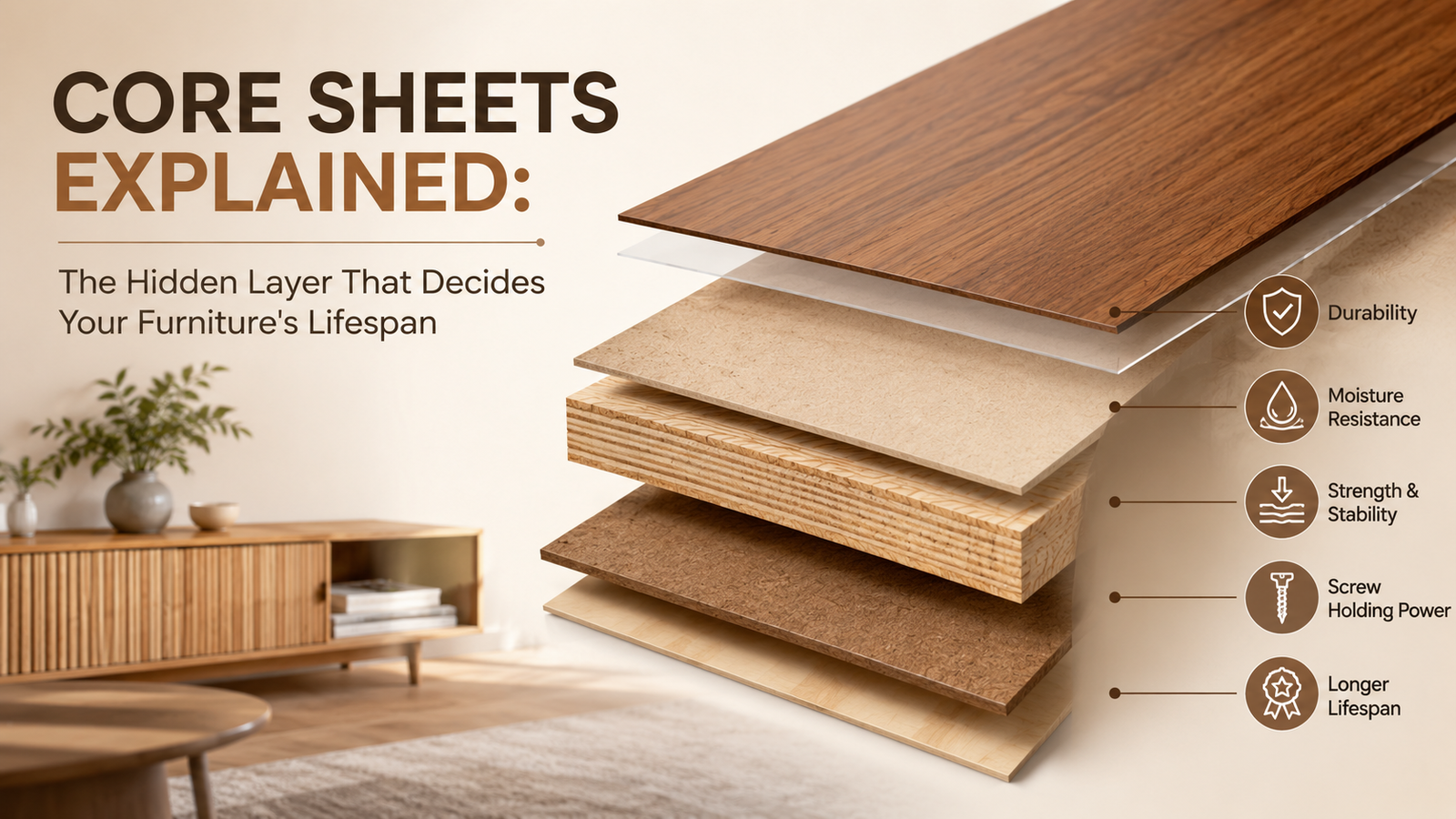
A core sheet is the inner layer (or layers) of wood veneer sandwiched between the top and bottom face veneers of a plywood sheet. Think of plywood as a layered cake — the outer layers give it a smooth, attractive surface, but the core layers give it strength, weight-bearing capacity, and resistance to warping.
Plywood is built using cross-laminated veneers, meaning each layer is placed at a 90-degree angle to the one below it. This crisscross structure is what gives plywood its dimensional stability. But not all core sheets are created equal — the type of wood used, the thickness of each veneer, and the number of layers directly impact how long your furniture will last.
Why the Core Matters More Than the Surface
Here's a fact most people don't realize: two plywood sheets can look identical on the outside and still perform completely differently based on their internal core quality.
A weak core leads to:
- Sagging shelves within a few years
- Screws loosening from cabinet hinges and hardware
- Warping in humid conditions
- Reduced load-bearing capacity for wardrobes, kitchen units, and TV units
- Delamination (layers separating) over time
A strong, well-engineered core provides:
- Consistent strength across the entire sheet
- Better screw and nail holding capacity
- Resistance to moisture and termite damage
- A longer functional lifespan for furniture exposed to daily use
This is exactly why, at Plylam Centre, customers are guided to inspect the core construction — not just the surface finish — before finalizing any plywood purchase.
Types of Core Construction You Should Know
1. Veneer Core
Made entirely of thin wood veneers layered and glued together. This is the most common and generally strongest type of core, offering excellent screw-holding strength and structural integrity — ideal for wardrobes, cabinets, and heavy-use furniture.
2. Combi Core (Combination Core)
A mix of veneer layers and a particleboard or MDF center layer. It's lighter and more budget-friendly but doesn't hold screws as firmly as a full veneer core, making it better suited for lighter applications like decorative panels.
3. LVL Core (Laminated Veneer Lumber)
Used in high-end, heavy-duty applications. LVL cores are engineered for maximum strength and are typically found in marine or BWR (Boiling Water Resistant) grade plywood.
4. Block Board Core
Instead of thin veneers, this uses solid wood strips as the core, covered with veneer on both sides. It's excellent for long, unsupported spans like door frames and long shelves, offering great strength-to-weight ratio.
How to Check Core Quality Before You Buy
You don't need to be a carpentry expert to evaluate core quality. Here's a simple checklist:
- Check the edge: Look at the cut edge of the plywood sheet. You should see uniform, tightly packed layers with no visible gaps or voids.
- Weight test: Genuine hardwood-core plywood feels noticeably heavier than low-grade alternatives of the same size.
- Tap test: A solid core produces a dense, consistent sound when tapped. Hollow or inconsistent sounds indicate gaps inside.
- Ask for the grade: Always ask whether it's MR (moisture resistant), BWR, or BWP (boiling waterproof) grade, since this affects how the core reacts to moisture over time.
- Buy from a trusted source: Quality control at the manufacturing stage is something you simply can't verify visually — this is why sourcing from an established plywood store matters as much as the product itself.
Core Sheet Quality: A Quick Comparison
| Core Type | Strength | Screw Holding | Best Use Case |
|---|---|---|---|
| Veneer Core | High | Excellent | Wardrobes, cabinets, daily-use furniture |
| Combi Core | Moderate | Average | Decorative panels, low-load furniture |
| LVL Core | Very High | Excellent | Heavy-duty, marine-grade applications |
| Block Board | High | Good | Long shelves, door frames |
Why Local Sourcing Matters for Hyderabad Homes
Hyderabad's climate — hot summers followed by a humid monsoon — puts extra stress on furniture-grade wood. Core sheets that aren't properly treated for moisture resistance tend to swell, warp, or develop fungal issues faster in this environment than in drier regions.
This is precisely why residents across Narsingi and Goshamahal are increasingly searching for a "plywood store near me" that understands local climate demands rather than simply stocking generic inventory. A knowledgeable best plywood store doesn't just sell sheets — it helps you match the core type to your specific furniture use, budget, and durability expectations.
At Plylam Centre, every plywood recommendation takes into account the humidity, usage pattern, and furniture type — because the right core sheet today means fewer repairs, replacements, and repolishing costs years down the line.
Making the Right Choice for Your Furniture
Before your next furniture project — whether it's a modular kitchen, wardrobe, or office cabinet — ask your supplier one simple question: "What core is this plywood built with?"
If they can't answer clearly, that's a red flag. The core sheet is not a minor technical detail; it's the foundation your entire piece of furniture rests on. Choosing wisely at this stage saves you from expensive repairs and premature replacements later.
Visit Plylam Centre to see and compare different core constructions firsthand, and get guidance suited to your specific furniture needs.
Frequently Asked Questions
1. What is a core sheet in plywood?
A: A core sheet is the inner layer (or layers) of a plywood panel, sandwiched between the top and bottom face veneers. It provides the structural strength that determines how well the plywood resists bending, warping, and load stress.
2. Which core type is best for wardrobes and cabinets?
A: Veneer core plywood is generally the best choice for wardrobes and cabinets because it offers superior screw-holding strength and consistent durability under daily use.
3. How can I check plywood core quality without cutting it open?
A: Look at the sheet's exposed edge for uniform, gap-free layers, compare weight against similar-sized sheets, and do a simple tap test — a solid core sounds dense, while a weak one sounds hollow.
4. Does core quality affect moisture resistance?
A: Yes. While the grade (MR, BWR, BWP) determines waterproofing treatment, the core construction affects how well the plywood holds its shape and strength when exposed to humidity over time.
5. Is blockboard a good option for long shelves?
A: Yes, Block Board core is particularly suited for long, unsupported shelves and door frames because its solid wood strip core offers a strong strength-to-weight ratio.
6. Why does Hyderabad's climate matter when choosing plywood?
A: Hyderabad experiences hot, humid conditions during monsoon months, which can cause poor-quality core sheets to swell or warp. Choosing moisture-resistant, well-constructed core plywood helps furniture last longer in this climate.
7. What's the difference between Combi Core and Veneer Core?
A: Combi Core mixes veneer layers with a particleboard or MDF center, making it lighter but less strong. Veneer Core uses only wood veneers throughout, offering higher strength and better screw retention.
8. How do I find a reliable plywood store near me in Narsingi or Goshamahal?
A: Look for a store with transparent grading information, a wide range of core constructions on display, and staff who can explain suitability based on your furniture type — not just push the cheapest option.
9. Does a stronger core mean a higher price?
A: Generally, yes — stronger cores like Veneer or LVL cost more upfront but reduce long-term costs by preventing sagging, warping, and premature furniture replacement.
10. Can I request specific core types when ordering custom furniture?
A: Absolutely. A good plywood store will let you choose the core construction based on your furniture's purpose, whether it's for heavy daily use, decorative panels, or long-span shelving.
More Blogs

Turn Your Dream Spaces Into Reality
Narsingi Branch
1-79, Osman Sagar Rd, beside South India Bank, Manchirevula, Narsingi, Telangana 500075
https://goo.gl/maps/31oyDP4wo8zjLhyw7
Contact:
+91 998 999 0105
+91 868 864 6761
Goshamahal Branch
5-5-685, Pink House, Goshamahal, Hyderabad, Telangana 500012


Contact Information:
+91 998 999 0105 +91 868 864 6761 040 2465 4077 040 6674 6699 040 6641 2737 +91 998 999 0104Email address:
Plylam_centre@yahoo.com
© Plylam Centre, All Right Reserved.
Designed and Developed by 10ODM.