Plywood vs MDF vs Particle Board: Which Is Best for Your Furniture?
Plywood vs MDF vs Particle Board: Which Is Best for Your Furniture?
Choosing between plywood, MDF, and particle board is one of the most consequential decisions in any furniture or interior project, yet it's often made based on price alone. Each material behaves differently under load, moisture, and daily use — and the wrong choice, even in a well-designed piece, can lead to sagging shelves, swollen edges, or hardware that no longer holds firmly within a few years.
This comparison breaks down how these three materials actually perform, so you can identify the best material for furniture based on your specific application — not just what's cheapest at the store.
Understanding the Three Materials
Before comparing performance, it helps to understand what each material actually is.
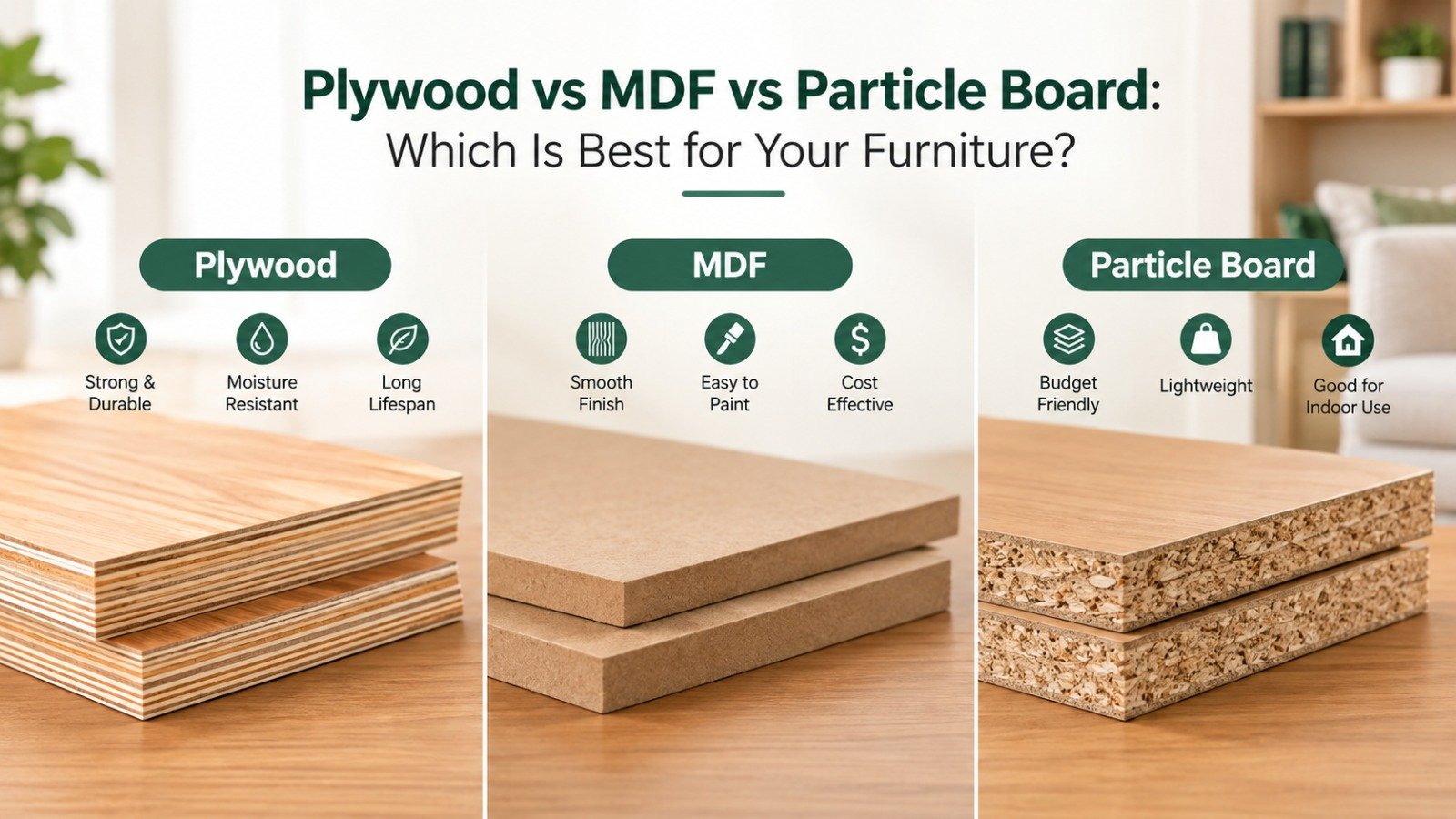
Plywood is made by gluing thin layers of wood veneer together, with each layer's grain running perpendicular to the next. This cross-graining gives plywood its strength and resistance to warping.
MDF (Medium-Density Fibreboard) is made by breaking wood down into fine fibers, then combining them with resin and compressing them under heat into dense, uniform sheets. It has no visible grain and a smooth, consistent surface.
Particle board is made from wood chips, sawdust, and shavings bonded together with resin under pressure. It's the least dense of the three and generally the most affordable.
Strength and Durability Comparison
Strength is often the deciding factor for furniture that needs to bear weight or withstand daily handling.
Plywood offers the highest strength-to-weight ratio of the three. Its layered, cross-grain construction resists bending, sagging, and cracking, making it reliable for load-bearing furniture like wardrobes, bookshelves, and kitchen cabinets.
MDF is strong under even, distributed pressure but more prone to sagging over long, unsupported spans — such as wide shelves — compared to plywood.
Particle board is the weakest of the three. It handles light use reasonably well but tends to crumble or lose structural integrity under sustained weight or repeated stress.
For furniture that will carry real weight over years of use, plywood consistently outperforms both alternatives.
Moisture and Humidity Resistance
This is where the differences become most significant, especially in humid climates like Hyderabad's.
Plywood — particularly BWR (Boiling Water Resistant) or BWP (Boiling Water Proof) grades — handles humidity and occasional moisture far better than the other two options, making it the standard choice for kitchens and bathrooms.
MDF absorbs moisture readily unless specifically treated (moisture-resistant MDF exists but costs more) and tends to swell along edges when exposed to humidity.
Particle board performs worst in moisture-prone conditions. It swells, weakens, and can disintegrate with sustained exposure to water or high humidity.
For any furniture near kitchens, bathrooms, or in regions with monsoon humidity, plywood is almost always the safer long-term investment.
Screw and Hardware Holding Capacity
Furniture longevity often comes down to how well a material holds screws, hinges, and fittings over repeated use.
Plywood holds screws firmly and can be re-drilled or adjusted without significant loss of grip, making it ideal for cabinets, drawers, and frequently opened doors.
MDF holds screws reasonably well on the first fitting but loses grip quickly if hardware is removed and reinserted, since its fiber structure doesn't reform around the screw threads.
Particle board has the weakest holding capacity, and hinges or handles can loosen with regular use over time.
Surface Finish and Aesthetic Flexibility
MDF offers the smoothest, most uniform surface, making it the preferred base for painted finishes, intricate router-cut designs, and veneering.
Plywood takes laminate, veneer, and paint finishes well, though its natural grain can show through lighter finishes unless properly prepped.
Particle board accepts laminate finishes but has a rougher, less refined surface underneath, limiting design flexibility for detailed or curved work.
Cost Comparison
Budget is often the starting point for material decisions, and the difference is notable:
- Particle board is the most affordable, making it common in budget furniture and temporary fittings
- MDF sits in the mid-range, offering a smoother finish at a moderate price
- Plywood costs more upfront but typically offers the best long-term value due to durability and moisture resistance
Which Material Should You Choose?
The best board for furniture ultimately depends on the specific application:
- Choose plywood for kitchen cabinets, wardrobes, load-bearing shelves, and anything exposed to moisture or daily wear
- Choose MDF for painted furniture, decorative panels, and interior pieces where a smooth finish matters more than moisture resistance
- Choose particle board only for low-cost, low-load, temporary furniture where budget is the primary concern
For most Indian homes — particularly in humid regions like Hyderabad — plywood remains the more dependable choice for furniture meant to last.
Making the Right Choice for Your Project
There's no single material that works best for every application — the right choice depends on load requirements, moisture exposure, budget, and desired finish. However, for furniture that needs to withstand years of daily use, humidity, and structural stress, plywood consistently delivers the best balance of strength, durability, and long-term value among plywood, MDF, and particle board.
If you're planning a renovation or new furniture project in Hyderabad and want guidance on selecting the right material and grade for your specific needs, Plylam Centre offers certified plywood options along with practical advice on matching material to application — rather than a one-size-fits-all recommendation.
Frequently Asked Questions
Q1: Which is stronger — plywood, MDF, or particle board?
Plywood is the strongest of the three due to its cross-layered construction, offering better resistance to bending, sagging, and cracking under weight compared to MDF or particle board.
Q2: Which material is best for kitchen cabinets — plywood or MDF?
Plywood, particularly BWR or BWP grade, is better suited for kitchen cabinets due to its superior moisture resistance and screw-holding capacity compared to MDF.
Q3: Is MDF a good choice for humid climates like Hyderabad?
Standard MDF absorbs moisture readily and isn't ideal for humid climates unless it's a moisture-resistant variant, which costs more. Plywood generally performs better in such conditions.
Q4: Why does particle board furniture wear out faster than plywood?
Particle board has lower density and weaker internal bonding, making it more prone to swelling, crumbling, and losing screw grip under regular use compared to plywood.
Q5: Is MDF or plywood better for painted furniture?
MDF offers a smoother, more uniform surface, making it the preferred choice for painted finishes and detailed router-cut designs.
Q6: What is the best material for furniture on a tight budget?
Particle board is the most affordable option, but it's best reserved for low-load, temporary furniture rather than pieces meant to last many years.
Q7: Can particle board handle heavy books or kitchen items?
Particle board isn't recommended for heavy or sustained loads, as it tends to sag or weaken over time. Plywood is a more reliable choice for load-bearing applications.
Q8: Does plywood cost more than MDF and particle board?
Yes, plywood typically costs more upfront, but its durability and moisture resistance often make it more cost-effective over the furniture's lifetime.
Q9: Which material holds screws and hardware best over time?
Plywood holds screws most reliably, even after repeated removal and reinsertion, making it ideal for cabinets, hinges, and frequently used furniture fittings.
Q10: Where can I get quality plywood for furniture in Hyderabad?
Plylam Centre supplies certified plywood suited to different furniture applications in Hyderabad, along with guidance on choosing the right grade based on load, moisture exposure, and finish requirements.
More Blogs

Turn Your Dream Spaces Into Reality
Narsingi Branch
1-79, Osman Sagar Rd, beside South India Bank, Manchirevula, Narsingi, Telangana 500075
https://goo.gl/maps/31oyDP4wo8zjLhyw7
Contact:
+91 998 999 0105
+91 868 864 6761
Goshamahal Branch
5-5-685, Pink House, Goshamahal, Hyderabad, Telangana 500012


Contact Information:
+91 998 999 0105 +91 868 864 6761 040 2465 4077 040 6674 6699 040 6641 2737 +91 998 999 0104Email address:
Plylam_centre@yahoo.com
© Plylam Centre, All Right Reserved.
Designed and Developed by 10ODM.