Monsoon-Proofing Your Furniture: Why Waterproof Plywood Matters in Hyderabad
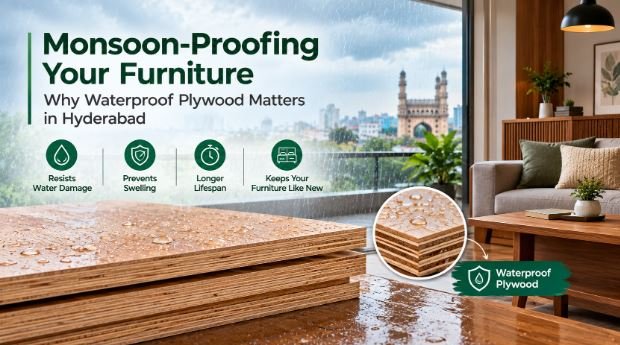
Monsoon-Proofing Your Furniture: Why Waterproof Plywood Matters in Hyderabad
Hyderabad's monsoon months bring humidity levels that most furniture material simply isn't built to withstand. Cabinets swell, doors stop closing properly, and modular kitchen shutters develop that unmistakable musty smell — all signs of plywood absorbing moisture it was never designed to handle. The material choice made months earlier, often invisible once installed, ends up determining whether your furniture survives the season intact.
This is where waterproof plywood becomes less of an upgrade and more of a necessity for anyone building or renovating in Hyderabad.
How Monsoon Humidity Actually Damages Furniture
Moisture doesn't need standing water to cause damage. Hyderabad's monsoon humidity alone is enough to trigger:
- Swelling along panel edges and joints
- Delamination, where veneer layers separate from each other
- Warping that misaligns doors, drawers, and shutters
- Fungal growth and a persistent musty odor inside cabinets
- Weakened screw grip, leading to loose hinges and hardware
Once this damage starts, it rarely reverses. Repainting or resealing a warped panel doesn't restore its original strength — the core has already absorbed moisture unevenly.
What Makes Plywood "Waterproof" — And Why Grade Matters
Not all plywood sold in the market is built to handle Hyderabad's humidity, even if it looks similar on the surface. The difference comes down to the adhesive bonding used between layers:
MR (Moisture Resistant) Grade
Suitable only for dry, low-humidity interior use. This grade is not designed for monsoon conditions and is a common cause of furniture damage when used incorrectly in kitchens or bathroom units.
BWR (Boiling Water Resistant) Grade
A step up, offering reasonable resistance to humidity and occasional moisture — often used in kitchen cabinets and semi-exposed furniture.
BWP (Boiling Water Proof) Grade
This is genuine waterproof plywood, bonded with phenolic resin adhesive tested by prolonged boiling. It's built to withstand sustained humidity and moisture exposure without the layers separating — making it the right choice for Hyderabad's monsoon climate.
Choosing the correct grade for each application, rather than defaulting to the cheapest option, is what actually determines how furniture performs once the rains arrive.
Where Waterproof Plywood Matters Most in a Hyderabad Home
Some areas of a home are far more vulnerable to monsoon moisture than others. Prioritize waterproof plywood in:
- Modular kitchen cabinets and base units (constant exposure to steam and spills)
- Bathroom vanities and storage units
- Balcony or utility area furniture
- Wardrobes in ground-floor or poorly ventilated rooms
- Window and door frames exposed to driving rain
- Under-sink storage units
Living room or bedroom furniture in well-ventilated, upper-floor spaces can often use BWR grade, but anything near water sources or exposed to outdoor humidity should always use BWP-grade boards.
Signs You're Already Dealing With Moisture-Damaged Plywood
Before assuming furniture just needs a repaint, check for these early warning signs:
- Doors or drawers that suddenly stick or don't close flush
- Visible bubbling or lifting at panel edges
- A musty smell when cabinets are opened
- Discoloration or dark patches along joints
- Screws that feel loose despite recent tightening
If two or more of these signs are present, the plywood core has likely already started absorbing moisture, and replacement — not just resealing — is usually the more reliable fix.
How to Monsoon-Proof New Furniture From the Start
Beyond choosing the right plywood grade, a few installation practices significantly extend furniture life through Hyderabad's rainy season:
- Seal all cut edges immediately after installation — this is where moisture enters first
- Apply exterior-grade paint or polyurethane coating to exposed surfaces
- Ensure adequate ventilation gaps behind cabinets and wardrobes
- Avoid placing furniture directly against damp or poorly insulated walls
- Use waterproof edge banding on kitchen and bathroom units specifically
Edge sealing is the detail most commonly skipped — and the one that causes the most damage when it's missed.
Choosing the Right Waterproof Plywood Supplier in Hyderabad
Not every plywood sold as "waterproof" in the local market actually meets BWP standards. Buyers should always:
- Ask for ISI certification (IS 303 or relevant IS standards)
- Request to see the batch's phenolic bonding grade in writing
- Inspect edge cross-sections for gaps or uneven layering before buying
Plylam Centre supplies ISI-certified waterproof plywood suited specifically to Hyderabad's monsoon conditions, with guidance on matching the correct grade — MR, BWR, or BWP — to each area of a home or commercial space. Rather than a one-size-fits-all recommendation, the focus stays on what will actually hold up through repeated monsoon cycles.
Making the Right Investment Before the Rains Arrive
Waterproof plywood typically costs more upfront than standard MR-grade boards, but the cost of replacing swollen cabinets, warped doors, or mold-damaged furniture almost always exceeds that initial difference. For anyone building or renovating in Hyderabad, treating waterproof plywood as a baseline requirement — not an optional upgrade — is the more economical decision over a furniture piece's lifetime.
If you're planning new furniture or a kitchen renovation before the next monsoon, sourcing certified BWP-grade stock from a reliable supplier like Plylam Centre is the most direct way to avoid these seasonal repair cycles altogether.
Frequently Asked Questions
Q1: What is waterproof plywood, anzd how is it different from regular plywood?
Waterproof plywood (BWP grade) uses phenolic resin adhesive tested by boiling, allowing it to resist sustained moisture without delaminating — unlike regular MR-grade plywood, which is only suitable for dry conditions.
Q2: Is waterproof plywood really necessary in Hyderabad?
Yes. Hyderabad's monsoon humidity is enough to cause swelling and delamination in standard plywood, even without direct water contact, making BWP-grade boards a practical necessity for kitchens, bathrooms, and exposed furniture.
Q3: Which furniture areas need waterproof plywood the most?
Kitchen cabinets, bathroom vanities, balcony furniture, and under-sink storage units face the highest moisture exposure and should always use BWP-grade waterproof plywood.
Q4: Can I convert existing MR-grade furniture to be more moisture-resistant?
Sealing edges and applying waterproof coatings can offer some protection, but they can't fully replicate the performance of genuine BWP-grade core material. Prevention through correct initial selection is more effective than after-the-fact treatment.
Q5: How can I tell if plywood is genuinely waterproof before buying?
Ask for ISI certification and written confirmation of BWP-grade phenolic bonding. Inspecting the edge cross-section for gaps or uneven layering also helps verify quality.
Q6: What are the earliest signs of monsoon moisture damage in furniture?
Sticking doors, a musty smell, bubbling at panel edges, and loose screws are typically the earliest indicators that plywood has started absorbing moisture.
Q7: Does waterproof plywood cost significantly more than regular plywood?
BWP-grade plywood costs more upfront than MR grade, but it typically avoids the repeated repair or replacement costs that moisture-damaged furniture requires over time.
Q8: Is BWR grade plywood enough for Hyderabad's monsoon, or do I need BWP?
BWR grade offers moderate moisture resistance and suits low-exposure areas, but kitchens, bathrooms, and outdoor-facing furniture require full BWP-grade protection for reliable monsoon performance.
Q9: Why does edge sealing matter so much for waterproof plywood?
Cut edges are the most common entry point for moisture, even in BWP-grade boards. Leaving them unsealed significantly reduces the plywood's effective water resistance.
Q10: Where can I buy certified waterproof plywood in Hyderabad?
Plylam Centre supplies ISI-certified BWP-grade waterproof plywood in Hyderabad, along with guidance on selecting the right grade for specific furniture and moisture-exposure needs.
More Blogs

Turn Your Dream Spaces Into Reality
Narsingi Branch
1-79, Osman Sagar Rd, beside South India Bank, Manchirevula, Narsingi, Telangana 500075
https://goo.gl/maps/31oyDP4wo8zjLhyw7
Contact:
+91 998 999 0105
+91 868 864 6761
Goshamahal Branch
5-5-685, Pink House, Goshamahal, Hyderabad, Telangana 500012


Contact Information:
+91 998 999 0105 +91 868 864 6761 040 2465 4077 040 6674 6699 040 6641 2737 +91 998 999 0104Email address:
Plylam_centre@yahoo.com
© Plylam Centre, All Right Reserved.
Designed and Developed by 10ODM.